
I was frankly skeptical when I heard that Executive Producer Marc Guggenheim had raved on Facebook about the FlashForward pilot. After all, Guggenheim was a creator of the earnest but mediocre Eli Stone, which had a great premise but poor execution. I'd also read Robert Sawyer's book Flashforward and seriously doubted the premise would translate to television.
I'm happy to report my skepticism was totally misplaced.
In fact, after watching the first episode, I wouldn't be surprised if I enjoy the show even more than the book. Sawyer's novel is less of a mystery -- the source of the blackout is revealed early on -- and more of a character study of the scientists who caused the event. Also, the flash forward therein catapults human consciousness 21 years into the future, instead of a mere six months. Obviously, these elements wouldn't make for much of a weekly show.
So, the TV version wisely changes things, making the cause of the flashforward a mystery and focusing upon FBI agents trying to piece together what happened. Indeed, while the pseudo-scientific premise -- particle accelerator malfunction -- may remain the same, the motive and identity of those responsible will probably be very different. My guess is that some sinister corporation has been experimenting with such an accelerator to time travel or affect probability.
The shorter jump makes sense, too, though I would have made it a full year. Six months is an awfully compressed time frame. Mark's vision of the Mosaic investigation and men with laser-sighted guns will probably occur in the first season finale. But such a major reveal should really take place later in the series, like season two or three. What I don't want is for the show to start each season with a similar flash that sets up the storylines for the year.
Still, that's a minor and speculative quibble. As I say, there's plenty to love about this show, including top notch writing and acting. Brannon Braga wrote "Cause and Effect," a classic Star Trek: TNG episode that takes a cool and unconventional approach to time travel. And David S. Goyer penned "The Dark Knight," one of my favorite films of any genre, ever. I'm less familiar with Guggenheim's work (besides Eli Stone) but know he has plenty of fans, too.
Jospeh Fiennes and Sonya Walger are both totally believable as husband and wife Mark and Olivia Benford. John Cho is also great as Mark's partner Demetri Noh, who doesn't have a vision and assumes it's because he'll be dead in six months. I buy Courtney B. Vance as their dapper and baritone FBI superior. Even Family Guy creator Seth MacFarlane is solid in his cameo as an agent on their team, though my first reaction was: "this guy's getting a little overexposed."
For some time now, ABC has looked in vain for the "next" LOST. Time will tell, but I think they may finally have found it in FlashForward.
***
Great shows usually grab me from the very start. I knew I would enjoy the Wire, Dexter, and Battlestar Galactica after the first episode or two. I was sold on LOST after the first promos. (Plane crashes are a major fear of mine.) In the case of Fringe, it took me a full season to fall in love.
I originally panned the show as too derivative of the X-Files, but you all everybody urged me to give it another chance. So I caught up on Hulu in time to watch the mind blowing season finale. And I'm not talking about Leonard Nimoy's freaky guest spot as the elusive William Bell, or the revelation that Pacey is from an alternate reality (which I already suspected). When they pulled back to reveal the twin towers of the World Trade Center...
Let's just say, as someone who was in Southern Manhattan and saw the towers fall with my own eyes, it was a powerful and disturbing image. It also illustrated brilliantly, on both literal and metaphorical levels, the mythology of the show. There is more than one of everything, including an alternate reality that differs in important ways from our own. One lingering question from the finale: are the towers standing because 9/11 never happened or is the alternate reality behind our own in time?
My casting concerns were overblown in retrospect. Pacey is more palatable than I'd imagined. And the writers have wisely toned down Lance Reddick's character, Agent Broyles, making him the quietly authoritative figure Reddick played so well on the Wire. Anna Torv is as adorable as ever -- I love Agent Dunham's bemused look when people try to BS her. Walter Bishop continues to be the most compelling character on the show, though the mysterious Nina Sharp is giving him a run for his money.
This season has gotten off to a slow start with stories returning to the show's X-Files roots. The possession of Agent Francis is an intriguing development. But his method of communicating with the mirror universe is a little cheesy. It would be creepier -- and make more sense -- if we could actually see another pair of hands typing in the mirror. I'm confident, however, that the show will regain steam once the focus returns to the engrossing main story arc.
Right now, my guess is that the two realities are unstable and destined eventually to merge into one. The coming battle is between "living receivers" (to borrow a phrase from Donnie Darko) like Agent Dunham whose special talents will facilitate the merging process. The winners of this inter-dimensional conflict will decide which version survives when alternate realities collide.
Tuesday, September 29, 2009

Tuesday, June 2, 2009
Breaking Bad: One Watery Deuce of a Finale
Tragedy struck in the skies over Albuquerque, New Mexico on Sunday. One of the best shows on television is missing and feared dead after a mid-air collision with the willing suspension of disbelief. The resulting fireball of absurdity was seen by people nationwide who tuned in expecting some compelling resolution to the mystery of the burned pink teddy bear.
Reports of frustrated viewers cursing at their televisions have been pouring in from across the country. Creator Vince Gilligan had this mildly pretentious comment on the tragedy:
Lucifer ex machina?
Pardon my Colonial, Vince, but are you frakkin' kidding me?
I get what you were trying to do. You wanted to show that Walt's actions have horribly unpredictable consequences, but in a way that didn't resort to cliches. The problem is that you set up a very compelling mystery with those teasing shots of the aforementioned pink bear and the body bags in the driveway at the start of several episodes. A lot of us spent the whole season puzzling over what could have burned the bear and who those bodies might be.
To satisfy me, the answers needed to be more than just surprising. They also had to be firmly rooted in events from this past season. We should have been able to rewatch the last 13 episodes and see old ocurrences in a new light. The shocking revelations in M. Night Shyamalan's best films like Unbreakable and the Sixth Sense work because they're clear in retrospect. Breaking Bad's twist was too random -- like learning the aliens in Signs are susceptible to water.
I don't even recall anyone mentioning that John Delancey's character worked in the airline industry. Still worse, his accident felt like some bad parody of those anti-drug commercials from the '80s with the eggs. This is drugs. This is your brain on drugs. This is the air-traffic controller who will cause a catastrophic accident between two passenger planes because his daughter died from an overdose of fried eggs...er, drugs.
The unforeseen evil of Walt's drug dealing could have been depicted just as disturbingly on a smaller scale. Remember how Jane's dad always attended recovery meetings with her? It seemed like the behavior of a protective father. But what if it turned out that he was an addict himself, and they originally sought treatment together? A far more devastating final scene for me would have been watching Donald relapse in despair, like Bubbles does near the end of the first season of the Wire.
The explosion could have been caused by the tankless water heater that Walt bought with tainted proceeds from his drug sales. The blast should have killed Marie, whose character is going nowhere, and maybe a reporter at the house to interview Walter, Jr., thus highlighting the harm to innocent bystanders. The shock and symbolism of such a freak accident would have been just as powerful. Indeed, the tragedy would have been all the more horrifying for its plausibility.
Many, myself included, have noted the numerous Sopranos references this season on Breaking Bad. Walt and Jesse's getting caught in the desert resembled Christopher and Paulie's plight in the famous Pine Barrens episode. Walt's facilitating Jane's asphyxiation was reminiscent of Tony smothering an injured Christopher in Kennedy and Heidi. If the Season 2 Finale has a parallel, it's to the classic Sopranos installment College.
Tony and his daughter Meadow travel to Maine to visit colleges. While at the gas station, Tony unexpectedly spies a mob informant who disappeared into witness protection. Tony stalks the man to his home, planning to kill him, but hesitates upon realizing his family is present. It's unclear whether Tony will follow through, until he does in a shockingly brutal climax where he strangles the turncoat. Later, Meadow notices blood on Tony's arm and realizes her father has been up to no good.
That episode brilliantly depicts how Tony's criminal activities impinge on his family life in unexpected and troubing ways. Even in idyllic Maine, on vacation with his daughter, Tony can't escape his obligations as a mobster. There are no mid-air collisions, not even a shootout, just one man strangling another while he pleads for his life. Yet the emotional impact of this climax is infinitely greater despite -- or perhaps because of -- its comparative banality.
There were touches of this in ABQ, particularly the storyline about Walt laundering money through Walter Junior's website. Senior's frustration at the relentless ringing of the bell brought to mind Poe's classic short, The Telltale Heart. It also evoked the mute, wheel-chair bound Tio (Ding!) one of my two favorite characters from this season -- the other being Bob Odenkirk's brilliant Saul Goodman. Speaking of Tio and Saul, where the hell were they?
I know, I know. Despite the aforementioned homages, it's not really fair comparing Breaking Bad to the Sopranos, which is one of the very best television shows ever. Still, I rate Breaking Bad among the top two or three shows currently on TV, which is why I'm so fiercely disappointed by this watery deuce of a finale. (Ding!) I haven't been so filled with righteous fury since the anti-climactic conclusion to Season 1 of Heroes.
I just hope this isn't a sign that Breaking Bad has similarly jumped the shark...
Reports of frustrated viewers cursing at their televisions have been pouring in from across the country. Creator Vince Gilligan had this mildly pretentious comment on the tragedy:
In that moment, at the end of season two, [Walt] doesn't realize it, but he's responsible for the whole world figuratively coming to an end around him. It's not deus ex machina, there's another term we were talking about, Lucifer ex machina, "Devil from the machine" -- it's the opposite. It almost could feel kind of random, but it's not. It's a butterfly effect. All these gears have been turning, this particular outcome was stuff Walt put into motion a long time ago by choosing to cook crystal meth.The butterfly effect?
Lucifer ex machina?
Pardon my Colonial, Vince, but are you frakkin' kidding me?
I get what you were trying to do. You wanted to show that Walt's actions have horribly unpredictable consequences, but in a way that didn't resort to cliches. The problem is that you set up a very compelling mystery with those teasing shots of the aforementioned pink bear and the body bags in the driveway at the start of several episodes. A lot of us spent the whole season puzzling over what could have burned the bear and who those bodies might be.
To satisfy me, the answers needed to be more than just surprising. They also had to be firmly rooted in events from this past season. We should have been able to rewatch the last 13 episodes and see old ocurrences in a new light. The shocking revelations in M. Night Shyamalan's best films like Unbreakable and the Sixth Sense work because they're clear in retrospect. Breaking Bad's twist was too random -- like learning the aliens in Signs are susceptible to water.
I don't even recall anyone mentioning that John Delancey's character worked in the airline industry. Still worse, his accident felt like some bad parody of those anti-drug commercials from the '80s with the eggs. This is drugs. This is your brain on drugs. This is the air-traffic controller who will cause a catastrophic accident between two passenger planes because his daughter died from an overdose of fried eggs...er, drugs.
The unforeseen evil of Walt's drug dealing could have been depicted just as disturbingly on a smaller scale. Remember how Jane's dad always attended recovery meetings with her? It seemed like the behavior of a protective father. But what if it turned out that he was an addict himself, and they originally sought treatment together? A far more devastating final scene for me would have been watching Donald relapse in despair, like Bubbles does near the end of the first season of the Wire.
The explosion could have been caused by the tankless water heater that Walt bought with tainted proceeds from his drug sales. The blast should have killed Marie, whose character is going nowhere, and maybe a reporter at the house to interview Walter, Jr., thus highlighting the harm to innocent bystanders. The shock and symbolism of such a freak accident would have been just as powerful. Indeed, the tragedy would have been all the more horrifying for its plausibility.
Many, myself included, have noted the numerous Sopranos references this season on Breaking Bad. Walt and Jesse's getting caught in the desert resembled Christopher and Paulie's plight in the famous Pine Barrens episode. Walt's facilitating Jane's asphyxiation was reminiscent of Tony smothering an injured Christopher in Kennedy and Heidi. If the Season 2 Finale has a parallel, it's to the classic Sopranos installment College.
Tony and his daughter Meadow travel to Maine to visit colleges. While at the gas station, Tony unexpectedly spies a mob informant who disappeared into witness protection. Tony stalks the man to his home, planning to kill him, but hesitates upon realizing his family is present. It's unclear whether Tony will follow through, until he does in a shockingly brutal climax where he strangles the turncoat. Later, Meadow notices blood on Tony's arm and realizes her father has been up to no good.
That episode brilliantly depicts how Tony's criminal activities impinge on his family life in unexpected and troubing ways. Even in idyllic Maine, on vacation with his daughter, Tony can't escape his obligations as a mobster. There are no mid-air collisions, not even a shootout, just one man strangling another while he pleads for his life. Yet the emotional impact of this climax is infinitely greater despite -- or perhaps because of -- its comparative banality.
There were touches of this in ABQ, particularly the storyline about Walt laundering money through Walter Junior's website. Senior's frustration at the relentless ringing of the bell brought to mind Poe's classic short, The Telltale Heart. It also evoked the mute, wheel-chair bound Tio (Ding!) one of my two favorite characters from this season -- the other being Bob Odenkirk's brilliant Saul Goodman. Speaking of Tio and Saul, where the hell were they?
I know, I know. Despite the aforementioned homages, it's not really fair comparing Breaking Bad to the Sopranos, which is one of the very best television shows ever. Still, I rate Breaking Bad among the top two or three shows currently on TV, which is why I'm so fiercely disappointed by this watery deuce of a finale. (Ding!) I haven't been so filled with righteous fury since the anti-climactic conclusion to Season 1 of Heroes.
I just hope this isn't a sign that Breaking Bad has similarly jumped the shark...
Monday, March 23, 2009
Battlestar Galactica: Series Finale
Since premiering as a mini-series in 2003, Battlestar Galactica has been one of the best shows of any genre on television. With consistently great writing, acting, and directing, BSG shattered the stereotype that science fiction can't be character driven. At its high points, moreover, the show was one of the few around to approach the mythological grandeur of Lost.
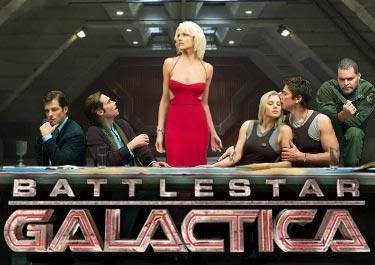
Nevertheless, I was nervous as I tuned in to see the series finale. For all of its merits, BSG faltered the last season or two in fulfilling the mythological promise of early episodes like Kobol's Last Gleaming. I was particularly disappointed with the revelation of the Final Five cylons and their backstory, a complaint I'll return to shortly. The penultimate episode, which was all loose ends, seemed to confirm my fear that BSG couldn't possibly tie things up in a satisfying way.
On the whole, however, I was satisfied with the finale. There were problems, particularly where the flashbacks to Caprica were concerned. The show tried to contrast the Colonials' empty existence surrounded by technology on Caprica with their embrace of a primitive existence on new Earth. But the shots of the strip club were absurd -- simultaneously heavy handed and prude. Memo to Eick and Moore: if you can't show nudity in a nudie bar, pick some other setting to make your point.
What I liked was the premise of the Colonials abandoning their technology and interbreeding with the primitive population on Earth. My favorite science fiction uses myth and science in mutually reinforcing ways. There are many legends of heavenly beings who fell to Earth and taught skills like farming and math to primitive humans. Among my favorites is the story of the Nephilim, whom the Old Testament describes as sons of God with a taste for mating with daughters of men.
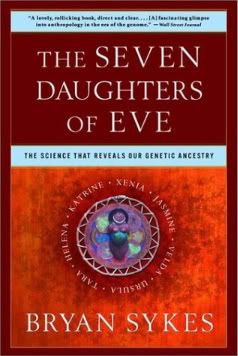
The master stroke was making Hera mitochondrial Eve. We often think of cavemen as our ancestors. In fact, as Brian Sykes describes in his book Seven Daughters of Eve, recent mitochondrial DNA analysis suggests we Homo Sapiens evolved separately between 100,000 and 200,000 years ago. About 80,000 years ago, we swept out of Africa in a mass migration, displacing and eventually extinguishing other Homo species like Neanderthalis. Now we know why: cylon-human hybrid vigor!
Some complain about the abrupt disappearance of Starbuck -- BSG's version of the Sopranos' fade to black. I personally bought it as a metaphor for Lee's relationship with Kara, whose free spirit remains forever out of his reach like the pigeon he chased around her apartment on Caprica. I also appreciated the pay-off for the prophetic dream of the Opera House. Having events play out on the "stage" of Galactica's bridge while the Final Five watched from the "balcony" was a nice twist.
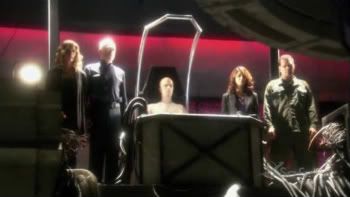
Unfortunately, that brings me back to my beef with the story of the Final Five. I frankly never believed them as brilliant scientists, particularly Ellen and Saul Tigh. And making them the last five survivors of the Thirteenth Tribe struck me as too clever by half, as did the revelation that the Thirteenth Tribe was actually cylon, not human. If I were Eick and Moore, I would have shifted the focus from the Final Five to the Cylon God, whom I would have made a renegade Lord of Kobol.
In my re-imagining of the re-imagined mythology, the Lords created humans for cheap labor, much as the latter would later create cylons. The aforementioned renegade Lord led a revolt on behalf of humanity that culminated in their exodus from Kobol. He guided the Thirteenth Tribe to Earth, then retired to an isolated island in the western ocean, only to watch the Tribe repeat the terrible cycle of events from Kobol by creating cylons and annhilating themselves with nukes.
The renegade Lord left Earth hoping to warn the other Twelve Tribes, but was intercepted by the cylons. Realizing he was too late to prevent war with the Colonies, he helped create humanoid cylons, who worshiped him in return as their Cylon God. As such, he was able to delay the cylons' annihilation of the Twelve Colonies long enough to find and plant the clues for the route to new Earth. The Final Five were his sleeper agents, unconsciously facilitating humanity's exodus until they awoke.
The Cylon God's plan would have culminated in humanity's realization on the original Earth that they were once slave labor themselves on Kobol. The Cylon God himself would probably be dead, killed secretly in some betrayal by brother Cavil, who caught wind of the covert plan to guide humanity to new Earth. But we also would have learned that the Cylon God created one of the Final Five in his own image. The fifth would have been revealed as Gaius Baltar, rather than Ellen Tigh.
Anyway, that's how I would have written it, but I suppose that's why Eick and Moore get the big bucks. Like I said, my criticisms and alternate mythology aside, I was reasonably pleased with how they wrapped up the series overall and look forward to the upcoming television film Battlestar Galactica: The Plan. What did you all everybody think?
Nevertheless, I was nervous as I tuned in to see the series finale. For all of its merits, BSG faltered the last season or two in fulfilling the mythological promise of early episodes like Kobol's Last Gleaming. I was particularly disappointed with the revelation of the Final Five cylons and their backstory, a complaint I'll return to shortly. The penultimate episode, which was all loose ends, seemed to confirm my fear that BSG couldn't possibly tie things up in a satisfying way.
On the whole, however, I was satisfied with the finale. There were problems, particularly where the flashbacks to Caprica were concerned. The show tried to contrast the Colonials' empty existence surrounded by technology on Caprica with their embrace of a primitive existence on new Earth. But the shots of the strip club were absurd -- simultaneously heavy handed and prude. Memo to Eick and Moore: if you can't show nudity in a nudie bar, pick some other setting to make your point.
What I liked was the premise of the Colonials abandoning their technology and interbreeding with the primitive population on Earth. My favorite science fiction uses myth and science in mutually reinforcing ways. There are many legends of heavenly beings who fell to Earth and taught skills like farming and math to primitive humans. Among my favorites is the story of the Nephilim, whom the Old Testament describes as sons of God with a taste for mating with daughters of men.
The master stroke was making Hera mitochondrial Eve. We often think of cavemen as our ancestors. In fact, as Brian Sykes describes in his book Seven Daughters of Eve, recent mitochondrial DNA analysis suggests we Homo Sapiens evolved separately between 100,000 and 200,000 years ago. About 80,000 years ago, we swept out of Africa in a mass migration, displacing and eventually extinguishing other Homo species like Neanderthalis. Now we know why: cylon-human hybrid vigor!
Some complain about the abrupt disappearance of Starbuck -- BSG's version of the Sopranos' fade to black. I personally bought it as a metaphor for Lee's relationship with Kara, whose free spirit remains forever out of his reach like the pigeon he chased around her apartment on Caprica. I also appreciated the pay-off for the prophetic dream of the Opera House. Having events play out on the "stage" of Galactica's bridge while the Final Five watched from the "balcony" was a nice twist.
Unfortunately, that brings me back to my beef with the story of the Final Five. I frankly never believed them as brilliant scientists, particularly Ellen and Saul Tigh. And making them the last five survivors of the Thirteenth Tribe struck me as too clever by half, as did the revelation that the Thirteenth Tribe was actually cylon, not human. If I were Eick and Moore, I would have shifted the focus from the Final Five to the Cylon God, whom I would have made a renegade Lord of Kobol.
In my re-imagining of the re-imagined mythology, the Lords created humans for cheap labor, much as the latter would later create cylons. The aforementioned renegade Lord led a revolt on behalf of humanity that culminated in their exodus from Kobol. He guided the Thirteenth Tribe to Earth, then retired to an isolated island in the western ocean, only to watch the Tribe repeat the terrible cycle of events from Kobol by creating cylons and annhilating themselves with nukes.
The renegade Lord left Earth hoping to warn the other Twelve Tribes, but was intercepted by the cylons. Realizing he was too late to prevent war with the Colonies, he helped create humanoid cylons, who worshiped him in return as their Cylon God. As such, he was able to delay the cylons' annihilation of the Twelve Colonies long enough to find and plant the clues for the route to new Earth. The Final Five were his sleeper agents, unconsciously facilitating humanity's exodus until they awoke.
The Cylon God's plan would have culminated in humanity's realization on the original Earth that they were once slave labor themselves on Kobol. The Cylon God himself would probably be dead, killed secretly in some betrayal by brother Cavil, who caught wind of the covert plan to guide humanity to new Earth. But we also would have learned that the Cylon God created one of the Final Five in his own image. The fifth would have been revealed as Gaius Baltar, rather than Ellen Tigh.
Anyway, that's how I would have written it, but I suppose that's why Eick and Moore get the big bucks. Like I said, my criticisms and alternate mythology aside, I was reasonably pleased with how they wrapped up the series overall and look forward to the upcoming television film Battlestar Galactica: The Plan. What did you all everybody think?
Saturday, March 7, 2009
Breaking Bad: Season Premier
I know I owe you all everybody some three-dot thoughts and replies to your awesome comments regarding La Fleur. But I have to take a break from the Lost talk for just a moment to plug another one of my favorite shows, Breaking Bad, which returns for a second season this Sunday, March 8, on AMC.
The premise is dark, but the story is told with plenty of humor. Bryan Cranston stars as Walter White, a high school chemistry teacher who is diagnosed with terminal lung cancer at the start of the series. To ensure the financial security of his pregnant wife and son with cerebral palsy, Walt secretly goes into business with a former student cooking and distributing crystal meth.
Cranston, who played the long-suffering dad on Malcolm in the Middle, brilliantly toes the line between drama and comedy with his performance. At the start of the series, you really believe that he's a wimpy science teacher. But by the time Walt walks into a den of criminals armed only with a handful of volatile chemicals, you also buy his transformation into a total badass:
And it's not just Cranston -- all of the main characters are perfectly cast. I'm particularly fond of Dean Norris, who plays Walt's brother-in-law Hank, a DEA agent. Hank is a kind of buffoonish Vic Mackey, a macho man who loves to goof on the nebishy Walter but with an undercurrent of affection that keeps the character sympathetic.
I also really enjoy RJ Mitte as Walt's son, Walter, Jr.. He captures well the quiet angst of an adolescent whose struggle for peer acceptance is complicated by his physical condition. I like that Mitte actually has cerebral palsy in real life. It galls me when shows try to pass off someone Chinese or Japanese as Korean. I'm looking at you, Sopranos...
The talented Vince Gilligan, formerly of the X-Files, created Breaking Bad. I was riveted literally from the start of his pilot, which has attained a kind of cult status in the entertainment industry. If you have a chance to watch the first nine episodes, I highly recommend them. But even if you can't, be sure to catch the start of Season 2 tomorrow night at 10pm on AMC.
The premise is dark, but the story is told with plenty of humor. Bryan Cranston stars as Walter White, a high school chemistry teacher who is diagnosed with terminal lung cancer at the start of the series. To ensure the financial security of his pregnant wife and son with cerebral palsy, Walt secretly goes into business with a former student cooking and distributing crystal meth.
Cranston, who played the long-suffering dad on Malcolm in the Middle, brilliantly toes the line between drama and comedy with his performance. At the start of the series, you really believe that he's a wimpy science teacher. But by the time Walt walks into a den of criminals armed only with a handful of volatile chemicals, you also buy his transformation into a total badass:
From Crackle:

And it's not just Cranston -- all of the main characters are perfectly cast. I'm particularly fond of Dean Norris, who plays Walt's brother-in-law Hank, a DEA agent. Hank is a kind of buffoonish Vic Mackey, a macho man who loves to goof on the nebishy Walter but with an undercurrent of affection that keeps the character sympathetic.
I also really enjoy RJ Mitte as Walt's son, Walter, Jr.. He captures well the quiet angst of an adolescent whose struggle for peer acceptance is complicated by his physical condition. I like that Mitte actually has cerebral palsy in real life. It galls me when shows try to pass off someone Chinese or Japanese as Korean. I'm looking at you, Sopranos...
The talented Vince Gilligan, formerly of the X-Files, created Breaking Bad. I was riveted literally from the start of his pilot, which has attained a kind of cult status in the entertainment industry. If you have a chance to watch the first nine episodes, I highly recommend them. But even if you can't, be sure to catch the start of Season 2 tomorrow night at 10pm on AMC.
Tuesday, March 3, 2009
Heroes: More Absurd than Ever
I like to whine about Heroes. In my opinion, the show jumped the shark at the end of Season 1 with its anti-climactic finale. Still, I'm a sucker for anything with superheroes, so I'm continuing to watch despite my reservations. Sadly, as last night's episode confirmed, the writing is as absurd as ever.
It's bad enough that they introduced a character who can breathe underwater. Talk about a lame power -- he can't even talk to the fishes like Aquaman! When Claire scrambled to hide him, I turned to my friend JZ (no, not that JZ) and made a crack about how she should just stash him in the jacuzzi.
I never expected the writers would actually stoop to stashing him in the jacuzzi.
Even worse, I think the show is poised to bring back one of my least favorite characters from seasons past. One mystery of S3 is the identity of REBEL, the anonymous computer hacker who has been helping our heroes at every turn. I'm guessing that REBEL is Micah, who can interface mentally with machines.
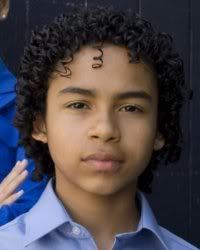
I don't know what it is about that kid, but he really creeps me out. I would totally buy him as, say, a murderous child psychopath...
It's bad enough that they introduced a character who can breathe underwater. Talk about a lame power -- he can't even talk to the fishes like Aquaman! When Claire scrambled to hide him, I turned to my friend JZ (no, not that JZ) and made a crack about how she should just stash him in the jacuzzi.
I never expected the writers would actually stoop to stashing him in the jacuzzi.
Even worse, I think the show is poised to bring back one of my least favorite characters from seasons past. One mystery of S3 is the identity of REBEL, the anonymous computer hacker who has been helping our heroes at every turn. I'm guessing that REBEL is Micah, who can interface mentally with machines.
I don't know what it is about that kid, but he really creeps me out. I would totally buy him as, say, a murderous child psychopath...
Wednesday, December 3, 2008
Review: Fringe and Life on Mars
Some of you have written recently asking about my thoughts on Fringe (Fox) and Life on Mars (ABC) two new shows in the same sci-fi vein as Lost. To be frank, I'm not a fan of either, though I'll admit some of my reasons are unreasonably subjective.
Let's begin with Life on Mars, which is actually a remake of a popular British show by the same name. I've never seen the original and have nothing in principle against remakes. Some of my best fr-...er, favorite flicks and shows are remakes. I'm a big fan of both the U.K. and U.S. versions of the Office. I adore the new Battlestar Galactica. I even prefer Soderbergh's remake of Solaris to the Tarkovsky original, which is among the most sacred of movie cows.
What annoys me about Life on Mars is the casting. You'd think they can't go wrong with the likes of Harvey Keitel, Michael Imperioli, and the uber-sexy Gretchen Mol in major roles. But all that star power just distracts from the story. I keep thinking how goofy Imperioli looks with a Ringo Starr mustache, and that Mol is just too preposterously hot to be a policewoman. The show reached a new low recently with Whoopie Goldberg's cameo as a gender-bending radio DJ.
Here's where things become unreasonably subjective. The episode with Whoopie featured several actors from the Wire (HBO) which is one of my all-time favorite shows. My initial excitement, however, turned to annoyance as the Wire guys were relegated to bit parts that made them look ridiculous. Chris Bauer's wig was laughably bad and Chad Coleman's Black Panther "uniform" looked like something recycled from an old Bond film -- one of the campy ones.
I was particularly troubled by the treatment of Clarke Peters. He had no lines of significance -- they cast him as a corpse. I'm not sure what troubled me more, the waste of talent or the disturbing image itself. To paraphrase the great Clay Davis: Lester Freamon...in a coffin? Sheeeit! Still, I'm fascinated enough by the premise of Life on Mars that I'll probably check out the ballyhooed British series. At the very least, I won't be distracted by the same casting issues I have with the U.S. version.
Related concerns drive my distaste for Fringe, which isn't technically a remake but might as well be. Everything about it seems calculated to evoke the X-Files -- from the opening credits, which reference a series of paranormal subjects, to the actual stories, one of which involved accelerated aging. I happen to love the X-Files, and the writers of Fringe have, in fairness, been quite forthright about their creative debt. The show simply suffers by comparison to a classic.
One change Fringe makes to the formula is to have a team of three paranormal investigators, instead of a pair like Mulder and Scully. Unfortunately, the addition just confirms the adage that three is a crowd. Anna Torv is appealing enough (I've got a thing for Home-Pride haircuts) and Walter Bishop is probably the best thing going for the show. But the latter's son, played by Joshua Jackson, rubs me all the wrong ways. I just can't get past my distaste for Pacey...feh!
Then there's the problem of Lance Reddick. He was brilliant as Lt. Cedric Daniels on the Wire and has been perfect as Matthew Abbadon on Lost. But Reddick strikes me as horribly miscast as Agent Broyles on Fringe. It seems to me they want him to strike a hostile note that's totally at odds with his cool persona. I can still hear his shrill refrain of "Li-a-son" from the Pilot ringing awkwardly in my ears. It really irks me to see such a supremely talented actor misused.
Here again, however, you see my unreasonable subjectivity in full effect, so take my reviews with a grain of salt.
Let's begin with Life on Mars, which is actually a remake of a popular British show by the same name. I've never seen the original and have nothing in principle against remakes. Some of my best fr-...er, favorite flicks and shows are remakes. I'm a big fan of both the U.K. and U.S. versions of the Office. I adore the new Battlestar Galactica. I even prefer Soderbergh's remake of Solaris to the Tarkovsky original, which is among the most sacred of movie cows.
What annoys me about Life on Mars is the casting. You'd think they can't go wrong with the likes of Harvey Keitel, Michael Imperioli, and the uber-sexy Gretchen Mol in major roles. But all that star power just distracts from the story. I keep thinking how goofy Imperioli looks with a Ringo Starr mustache, and that Mol is just too preposterously hot to be a policewoman. The show reached a new low recently with Whoopie Goldberg's cameo as a gender-bending radio DJ.
Here's where things become unreasonably subjective. The episode with Whoopie featured several actors from the Wire (HBO) which is one of my all-time favorite shows. My initial excitement, however, turned to annoyance as the Wire guys were relegated to bit parts that made them look ridiculous. Chris Bauer's wig was laughably bad and Chad Coleman's Black Panther "uniform" looked like something recycled from an old Bond film -- one of the campy ones.
I was particularly troubled by the treatment of Clarke Peters. He had no lines of significance -- they cast him as a corpse. I'm not sure what troubled me more, the waste of talent or the disturbing image itself. To paraphrase the great Clay Davis: Lester Freamon...in a coffin? Sheeeit! Still, I'm fascinated enough by the premise of Life on Mars that I'll probably check out the ballyhooed British series. At the very least, I won't be distracted by the same casting issues I have with the U.S. version.
Related concerns drive my distaste for Fringe, which isn't technically a remake but might as well be. Everything about it seems calculated to evoke the X-Files -- from the opening credits, which reference a series of paranormal subjects, to the actual stories, one of which involved accelerated aging. I happen to love the X-Files, and the writers of Fringe have, in fairness, been quite forthright about their creative debt. The show simply suffers by comparison to a classic.
One change Fringe makes to the formula is to have a team of three paranormal investigators, instead of a pair like Mulder and Scully. Unfortunately, the addition just confirms the adage that three is a crowd. Anna Torv is appealing enough (I've got a thing for Home-Pride haircuts) and Walter Bishop is probably the best thing going for the show. But the latter's son, played by Joshua Jackson, rubs me all the wrong ways. I just can't get past my distaste for Pacey...feh!
Then there's the problem of Lance Reddick. He was brilliant as Lt. Cedric Daniels on the Wire and has been perfect as Matthew Abbadon on Lost. But Reddick strikes me as horribly miscast as Agent Broyles on Fringe. It seems to me they want him to strike a hostile note that's totally at odds with his cool persona. I can still hear his shrill refrain of "Li-a-son" from the Pilot ringing awkwardly in my ears. It really irks me to see such a supremely talented actor misused.
Here again, however, you see my unreasonable subjectivity in full effect, so take my reviews with a grain of salt.
Monday, October 6, 2008
Heroes: Sylar and Peter Must Die...
Forget for a minute that Sylar is horribly miscast and the actor playing Peter is just plain horrible. The real problem with these characters is that they're way too powerful. Sure the writers might come up with ever more contrived ways for them to lose control of their powers or become otherwise disabled.
At some point, however, the show will become implausible, uninteresting, or both. Every season will boil down to yet another showdown between the two most powerful characters. The way I see it, there's only one way out of this narrative trap: Sylar and Peter must both die.
I've made no secret of my displeasure with the frankly sloppy writing that's marred the start of this season. The rock paintings that never fade after years in the sun was ridiculous. And the suggestion that Sylar and Peter are brothers strikes me as too much like a soap opera or fairy tale.
But the latter storyline may have a possible saving grace. I'd like to think Angela is plotting to change the future by ridding the world of evil mutantkind using Sylar. Once he's killed them and accumulated their powers, she will sacrifice Peter to rid the world of Sylar.
It's admittedly dark, but if Heroes has balls, that's where they'll go...
At some point, however, the show will become implausible, uninteresting, or both. Every season will boil down to yet another showdown between the two most powerful characters. The way I see it, there's only one way out of this narrative trap: Sylar and Peter must both die.
I've made no secret of my displeasure with the frankly sloppy writing that's marred the start of this season. The rock paintings that never fade after years in the sun was ridiculous. And the suggestion that Sylar and Peter are brothers strikes me as too much like a soap opera or fairy tale.
But the latter storyline may have a possible saving grace. I'd like to think Angela is plotting to change the future by ridding the world of evil mutantkind using Sylar. Once he's killed them and accumulated their powers, she will sacrifice Peter to rid the world of Sylar.
It's admittedly dark, but if Heroes has balls, that's where they'll go...
Subscribe to:
Posts (Atom)